

Shortwave Infrared Market Set for Rapid Expansion, Forecast to Hit USD 931.48 Million by 2035
Shortwave Infrared Market
Shortwave Infrared Market Size, Share and Research Report By Scanning Type (Area Scan, Line Scan), By Detector Technology (InGaAs, MCT (HgCdTe), CQD
Shortwave Infrared Market: Gaining traction across defense, industrial inspection, and imaging applications due to superior material detection and low-light performance.”
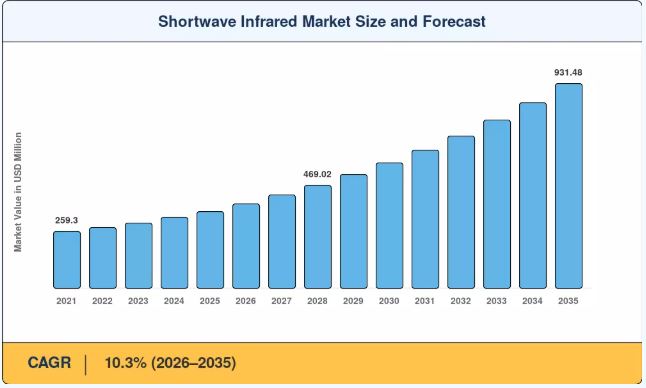
DENMARK, DENMARK, NORWAY, June 26, 2026 /EINPresswire.com/ -- The Global shortwave infrared market reached an estimated USD 349.50 million in 2025 and is projected to grow from to USD 931.48 million by 2035, registering a CAGR of 9.8% during the forecast period. — Market Research Future (MRFR)
Two major catalysts are driving this trajectory: the accelerating adoption of SWIR imaging in machine vision and industrial inspection applications where the ability to see through haze, moisture, and certain packaging materials at wavelengths between 900 nm and 1,700 nm delivers capabilities fundamentally unavailable to standard visible-light cameras and rapid advances in indium gallium arsenide (InGaAs) detector manufacturing that have reduced SWIR camera costs by over 50% since 2019. With SWIR imaging systems now deployed across semiconductor inspection, defense & surveillance, food sorting, solar cell characterization, and autonomous vehicle sensing, the technology is transitioning from a high-cost niche into a broadly accessible industrial vision platform.
Legacy silicon-based imaging systems are reaching fundamental physical limits in applications requiring near-infrared wavelength sensitivity, pushing system integrators, OEMs, and defense contractors toward SWIR-capable InGaAs and emerging alternative detector technologies. A recent analysis by the European Machine Vision Association estimated that SWIR-equipped inspection lines in semiconductor and flat-panel display manufacturing achieved defect detection rates 35–42% higher than comparable visible-light systems for subsurface and material-contrast anomalies. This capability gap is not closable through incremental visible-spectrum sensor improvement it reflects a fundamental photonic advantage of SWIR imaging that is driving irreversible adoption across precision manufacturing, security, and scientific instrumentation sectors.
Get Full PDF Sample Copy of Report: (Including Full TOC, List of Tables & Figures, Chart) @
https://www.marketresearchfuture.com/sample_request/7317
➤How Significant Is the Shortwave Infrared Market’s Growth?
The shortwave infrared market has demonstrated sustained and accelerating expansion, rising from approximately USD 201.4 million in 2021 to an estimated USD 312.7 million in 2025, reflecting a robust historical CAGR underpinned by defense modernization programs, expanding machine vision deployments in automotive and electronics manufacturing, and growing scientific instrumentation demand. The market is poised to nearly triple over the next decade, driven by the proliferation of SWIR cameras in autonomous vehicle LiDAR complement systems, accelerating adoption in pharmaceutical and food quality inspection, and the strategic integration of SWIR sensing capabilities into unmanned aerial vehicle (UAV) payloads for defense and agricultural surveillance.
The economics of SWIR adoption are increasingly favorable. Continued advances in wafer-scale InGaAs epitaxial growth, detector hybridization processes, and thermoelectric cooling integration have driven unit costs for SWIR camera modules from tens of thousands of dollars a decade ago to the low thousands today ith uncooled SWIR sensor arrays now approaching price points accessible for high-volume industrial and consumer applications. This cost trajectory is unlocking entirely new application categories, including in-line pharmaceutical tablet coating inspection, recycled plastic sorting by polymer type, and smart agriculture canopy stress mapping all of which require the wavelength selectivity that only SWIR imaging can provide at commercially viable cost points.
➤What Does the Future Hold for the Shortwave Infrared Market?
Alternative detector materials and integration architectures stand at the forefront of the market’s next growth phase. While InGaAs remains the dominant SWIR detector technology, significant R&D investment is flowing into colloidal quantum dot (CQD) sensors, germanium-on-silicon photodetectors, and extended-wavelength InGaAs arrays that can push sensitivity toward 2,500 nm. These emerging platforms promise to deliver SWIR sensing at silicon CMOS-compatible manufacturing costs, potentially enabling SWIR integration into consumer smartphones, wearables, and mass-market IoT devices within the forecast period.
Autonomous systems and artificial intelligence represent another defining force shaping the market’s future. SWIR cameras integrated into autonomous vehicle sensor suites provide critical performance advantages over visible-spectrum cameras in adverse weather rain, fog, and low-angle sun glare while simultaneously enabling lane marking detection through road surface moisture films and occupant monitoring through tinted windows. AI-powered SWIR image processing pipelines are enabling real-time material classification, anomaly detection, and 3D reconstruction from SWIR data streams, dramatically expanding the actionable intelligence extractable from SWIR imaging deployments across industrial, security, and mobility applications.
Defense and intelligence applications continue to represent the largest and most demanding segment of SWIR market demand. Third-generation night vision systems, laser designator spot tracking, covert surveillance through camouflage and foliage, and hyperspectral target identification platforms all rely on SWIR imaging capabilities that visible and thermal infrared systems cannot replicate. Sustained defense modernization budgets across NATO member states, the U.S. Department of Defense, and Asia-Pacific military organizations are creating durable, long-cycle procurement demand for high-performance SWIR imaging systems, sensors, and integrated electro-optical payloads.
➤Who Are the Key Players in the Shortwave Infrared Market?
The shortwave infrared market is characterized by a concentrated group of specialized imaging technology vendors, defense optoelectronics suppliers, and emerging photonics companies. Key participants shaping the competitive dynamics include:
✦Sensors Unlimited (a Collins Aerospace company) — a pioneer in InGaAs-based SWIR cameras and sensor arrays, serving defense, industrial, and scientific imaging markets with a comprehensive portfolio of cooled and uncooled SWIR imaging systems
✦FLIR Systems (a Teledyne Technologies company) — delivering a broad portfolio of SWIR and multispectral imaging cameras for defense, security, and industrial inspection applications, with strong integration into UAV and vehicle-mounted EO/IR systems
✦Xenics NV — a leading European developer of InGaAs and other infrared imaging solutions, offering SWIR cameras and linear arrays for scientific, industrial, and defense applications
✦Princeton Infrared Technologies — providing high-performance InGaAs focal plane arrays and camera systems for scientific, defense, and industrial SWIR imaging applications
✦Raptor Photonics — delivering ultra-low-noise SWIR and near-infrared scientific cameras for spectroscopy, astronomy, and life sciences research applications
✦Allied Vision Technologies — offering SWIR-capable industrial cameras integrated with GigE Vision and USB3 Vision interfaces for machine vision and automation applications
✦Hamamatsu Photonics — a global leader in photonics components providing InGaAs photodiodes, linear arrays, and area image sensors used extensively in SWIR spectroscopy and imaging instruments
✦Leonardo DRS — supplying advanced SWIR and multiband infrared detector assemblies and focal plane arrays for U.S. and allied defense imaging programs
✦Voxtel (acquired by Allegro MicroSystems) — developing high-performance InGaAs and avalanche photodiode-based SWIR detector arrays for LiDAR, ranging, and imaging applications
✦Photon etc. — providing hyperspectral SWIR imaging systems and global imaging spectroscopy instruments for semiconductor, life science, and photovoltaic research applications
Competition in the market is intensifying as vendors invest in next-generation detector fabrication processes, expand SWIR camera integration with AI inference hardware, and pursue dual-use technology strategies that leverage defense-driven R&D into commercial machine vision and autonomous systems markets. Strategic consolidation including Teledyne’s acquisition of FLIR and Collins Aerospace’s ownership of Sensors Unlimited is concentrating high-end SWIR technology within diversified defense and aerospace conglomerates, while specialized European and Asian photonics companies compete on performance differentiation and application-specific customization.
➤ What Are the Emerging Trends in the Shortwave Infrared Market?
Several transformational trends are redefining how the shortwave infrared market evolves through 2035:
Colloidal Quantum Dot (CQD) SWIR Sensors: Solution-processed CQD photodetector arrays are emerging as a potentially disruptive alternative to epitaxial InGaAs, offering the prospect of SWIR sensitivity fabricated on standard CMOS silicon wafers at a fraction of the cost with companies including SWIR Vision Systems and Emberion actively commercializing CQD-based SWIR imaging products.
SWIR Integration in Autonomous Vehicle Sensing: Automotive OEMs and Tier 1 suppliers are evaluating SWIR cameras as a complement to LiDAR, radar, and visible cameras in autonomous driving sensor stacks, with SWIR’s superior performance in rain, fog, and glare conditions providing critical redundancy in adverse weather scenarios.
Hyperspectral SWIR Imaging: The combination of SWIR wavelength coverage with hyperspectral imaging enables material composition mapping, pharmaceutical blend uniformity analysis, and precision agriculture applications that are rapidly expanding the addressable market beyond conventional broadband SWIR imaging.
Uncooled SWIR Detector Advances: Elimination of thermoelectric cooling through advanced InGaAs detector design and CQD sensor development is enabling smaller, lower-power, and lower-cost SWIR camera modules suitable for integration into UAVs, handheld devices, and high-volume industrial inspection systems.
Laser Safety & Eye-Safe LiDAR: The 1,550 nm SWIR wavelength band is eye-safe at significantly higher power levels than 905 nm near-infrared laser systems, driving adoption of SWIR-band LiDAR and range-finding systems in automotive, robotics, and defense applications where eye-safety compliance is mandatory.
Food & Pharmaceutical Inline Inspection: SWIR’s unique ability to detect moisture content, fat distribution, foreign body contamination, and tablet coating uniformity through packaging materials is driving rapid adoption in pharmaceutical manufacturing lines, food processing facilities, and recycling sortation plants seeking non-destructive, high-throughput quality assurance capabilities.
Get access to the full description of the report @
https://www.marketresearchfuture.com/reports/shortwave-infrared-market-7317
➤ How Is the Shortwave Infrared Market Segmented?
The shortwave infrared market report provides a comprehensive segmentation framework:
1 By Technology: Indium Gallium Arsenide (InGaAs), Colloidal Quantum Dot (CQD), Germanium-on-Silicon, Extended-Wavelength InGaAs, Others
2 By Product Type: SWIR Cameras, SWIR Sensors & Detectors, SWIR Modules & Systems, Hyperspectral SWIR Imaging Systems
3 By Application: Defense & Surveillance, Machine Vision & Industrial Inspection, Scientific & Research Imaging, Autonomous Vehicles & LiDAR, Food & Pharmaceutical Inspection, Solar Cell Characterization
4 By End User: Defense & Aerospace, Semiconductor & Electronics, Automotive, Food & Beverage, Pharmaceutical & Life Sciences, Research & Academia
5 By Organization Size: SMEs, Large Enterprises
➤ What Are the Regional Insights from the Shortwave Infrared Market?
North America commands approximately 38% of global shortwave infrared market share, driven by the world’s largest defense imaging procurement budgets, the concentration of leading InGaAs detector manufacturers and SWIR camera integrators, and strong demand from the U.S. semiconductor and advanced manufacturing sectors. The U.S. Department of Defense’s sustained investment in electro-optical/infrared (EO/IR) systems for ground vehicles, aircraft, naval vessels, and special operations equipment represents the single largest end-use demand driver in the global SWIR market, with multi-year procurement programs providing revenue visibility to leading domestic sensor suppliers.
Europe holds the second-largest share at approximately 24%, with Germany, France, the United Kingdom, and the Netherlands representing the primary markets. European defense modernization under NATO commitments, the EU’s Horizon Europe photonics research programs, and the strength of the regional machine vision and industrial automation ecosystem collectively support robust SWIR market demand. Key European SWIR vendors including Xenics (Belgium) and Raptor Photonics (UK) serve both regional and global markets from their European manufacturing and R&D bases.
Asia-Pacific represents the fastest-growing region, projected to register a CAGR above 12% through 2035, driven by China’s aggressive defense modernization and domestic semiconductor manufacturing ambitions, Japan’s world-class industrial machine vision and photonics manufacturing ecosystem, and South Korea’s expanding semiconductor and display panel inspection infrastructure. China’s indigenous SWIR detector development programs, supported by significant state R&D funding, are creating domestic supply chain alternatives to Western InGaAs sensor technology a trend accelerated by export control restrictions on advanced imaging sensors.
The Middle East is an emerging but significant market for defense-grade SWIR imaging, driven by active procurement of border surveillance, UAV payload, and armored vehicle electro-optical systems by GCC defense ministries. Countries including the UAE, Saudi Arabia, and Israel the latter home to a world-class defense optics and imaging industry represent important both demand and supply nodes in the global SWIR market ecosystem.
Latin America and Africa represent smaller but developing markets, primarily driven by agricultural remote sensing, border and maritime surveillance, and scientific research applications. Brazil’s precision agriculture sector the world’s largest soybean and sugarcane producer is emerging as a meaningful adopter of SWIR-based crop health and canopy stress monitoring via both satellite and UAV-mounted hyperspectral imaging platforms, creating incremental regional market demand beyond traditional defense-led procurement.
➤FAQs
Q-What was the valuation of the Area Scan segment in 2024?
The valuation of the Area Scan segment in 2024 was 0.1 USD Billion.
Q-What is the projected valuation for the Line Scan segment by 2035?
The projected valuation for the Line Scan segment is expected to reach 0.2736 USD Billion by 2035.
➤➤➤ Market Research Future's Regional Market Analysis:
Us Shortwave Infrared Market-
https://www.marketresearchfuture.com/reports/us-shortwave-infrared-market-17223
➤➤➤ Industry Analysis Reports by Market Research Future:
Capacitor Market-
https://www.marketresearchfuture.com/reports/capacitor-market-11905
Analog Semiconductor Market-
https://www.marketresearchfuture.com/reports/analog-semiconductor-market-11980
Wafer Level Packaging Market-
https://www.marketresearchfuture.com/reports/wafer-level-packaging-market-12295
Process Spectroscopy Market-
https://www.marketresearchfuture.com/reports/process-spectroscopy-market-12336
Monolithic Microwave Ic Market-
https://www.marketresearchfuture.com/reports/monolithic-microwave-ic-market-12372
Oven-Controlled Crystal Oscillator Ocxo Market-
https://www.marketresearchfuture.com/reports/oven-controlled-crystal-oscillator-ocxo-market-12376
Underfill Dispensers Market-
https://www.marketresearchfuture.com/reports/underfill-dispensers-market-12600
Micro Inverter Market-
https://www.marketresearchfuture.com/reports/micro-inverter-market-12609
China Robotics Market-
https://www.marketresearchfuture.com/reports/china-robotics-market-12667
Etch Equipment Market-
https://www.marketresearchfuture.com/reports/etch-equipment-market-13902
Sagar Kadam
Market Research Future
+1 628-258-0071
email us here
Legal Disclaimer:
EIN Presswire provides this news content "as is" without warranty of any kind. We do not accept any responsibility or liability for the accuracy, content, images, videos, licenses, completeness, legality, or reliability of the information contained in this article. If you have any complaints or copyright issues related to this article, kindly contact the author above.
