

spektrQ Gives Compliance Teams the Operational Map to Find AI Opportunities in Their Workflows

spektrQ addresses the growing gap between AI adoption and tangible AI impact in financial services compliance.
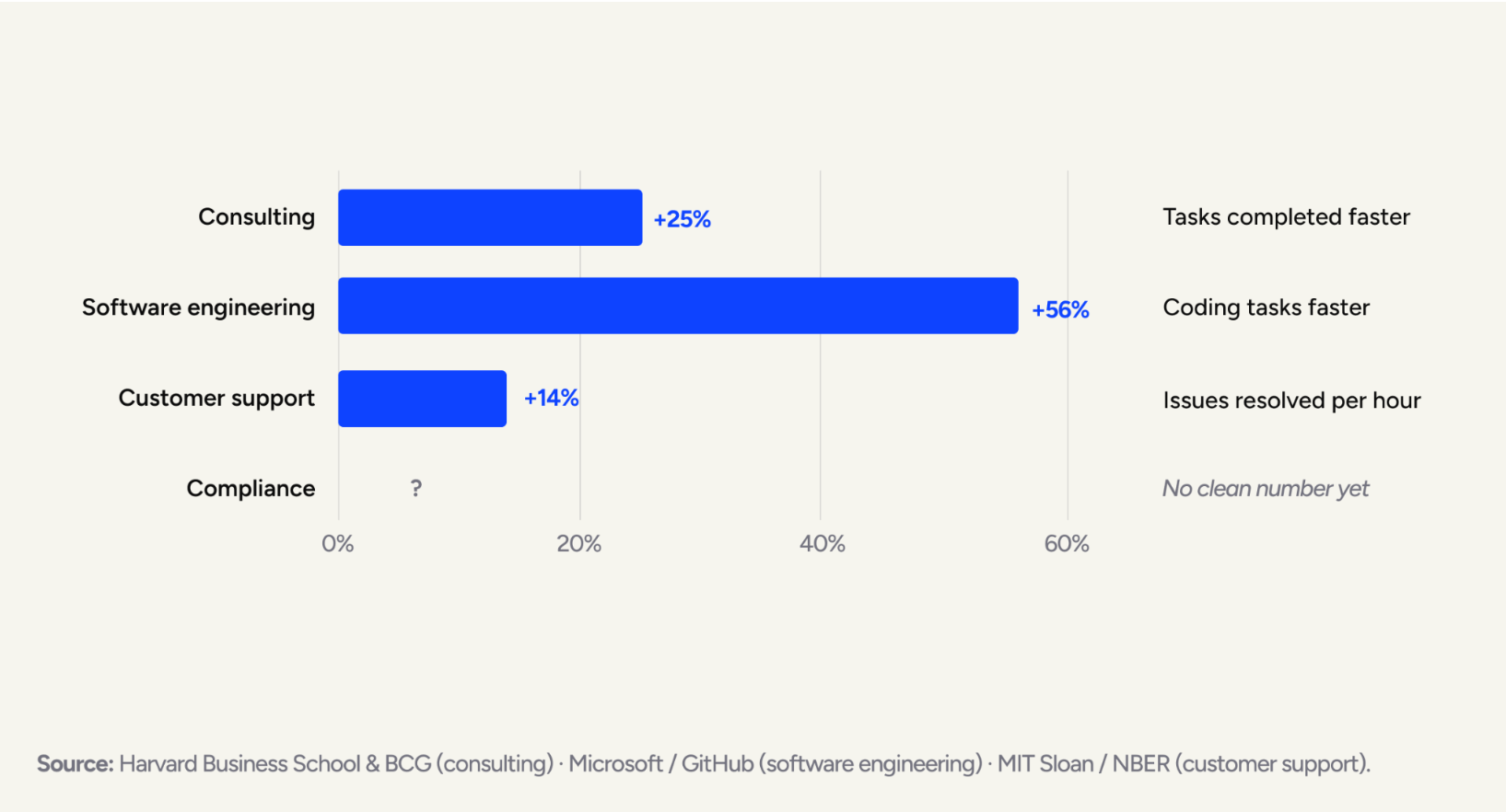
AI has delivered productivity gains across consulting (+25%), software engineering (+56%), and customer support (+14%). Compliance is the only function without a benchmark. Sources: Harvard Business School & BCG; Microsoft/GitHub; MIT Sloan/NBER.
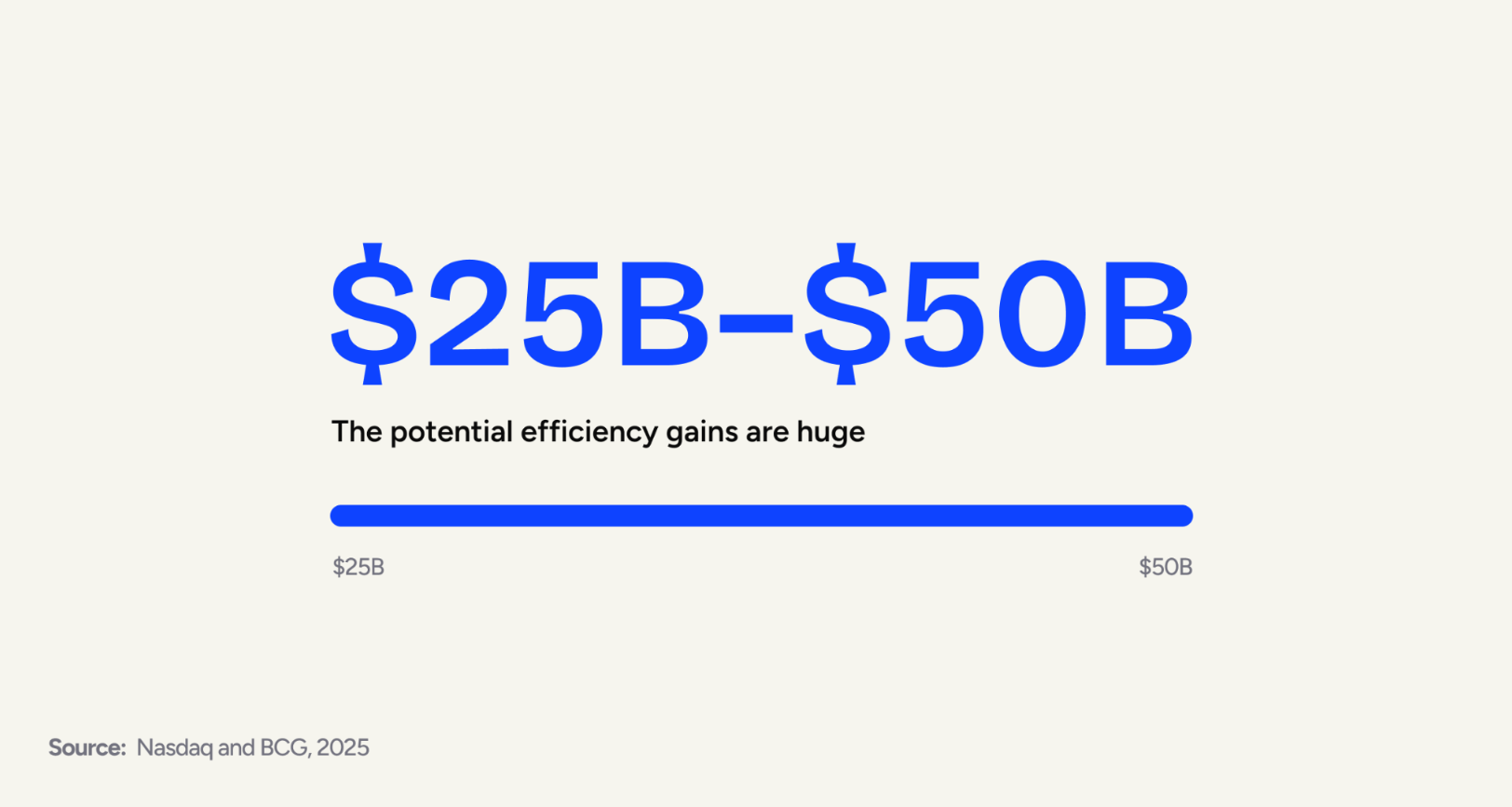
Nasdaq and BCG estimate $25 billion to $50 billion in potential annual efficiency gains across bank risk and compliance functions. Source: Nasdaq and BCG, 2025.
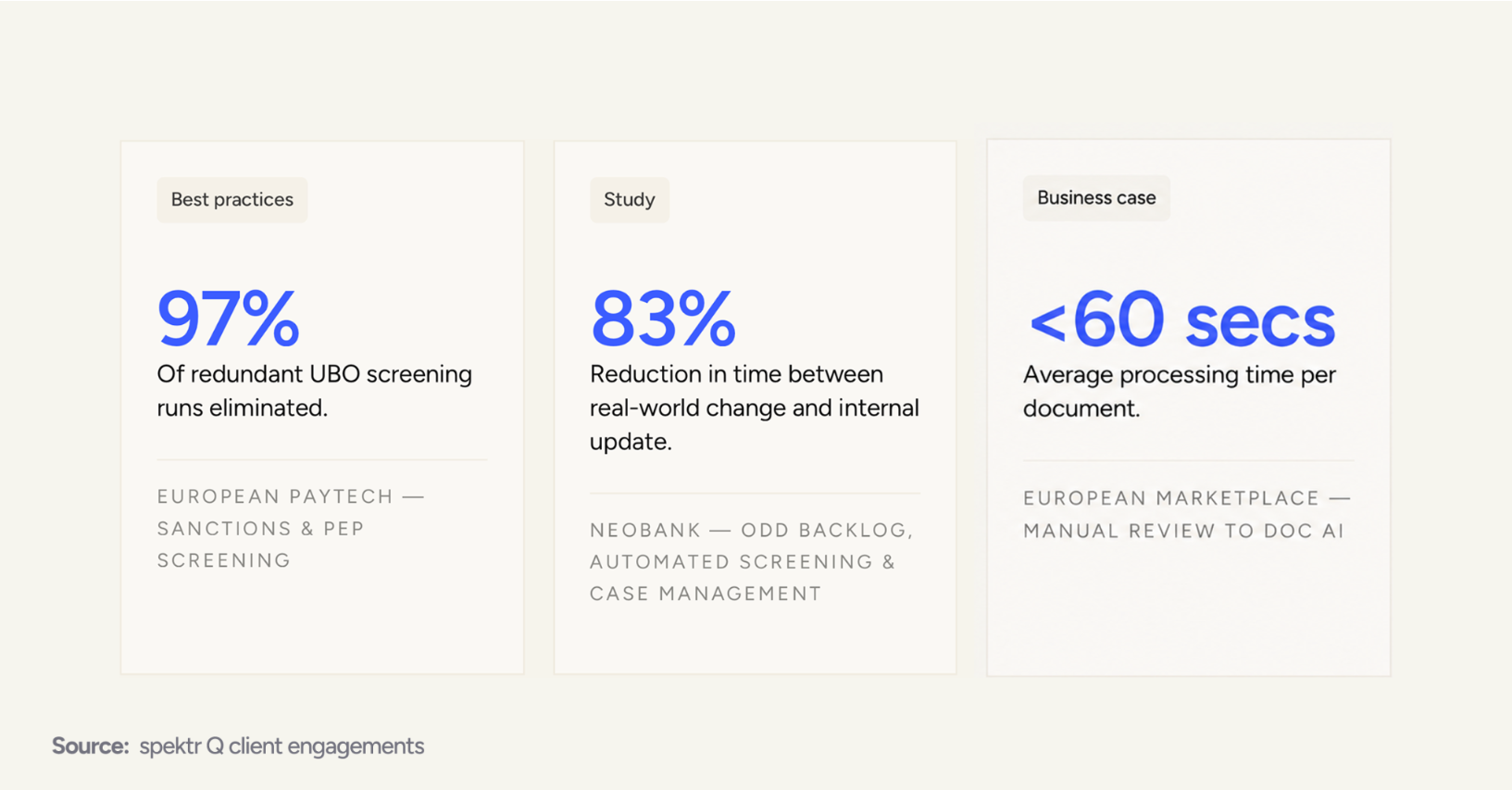
spektrQ engagements delivered a 97% cut in redundant UBO screening at a PayTech, an 83% reduction in real-world change response time at a neobank, and sub-60-second document processing at a large marketplace. Source: spektrQ client engagements.
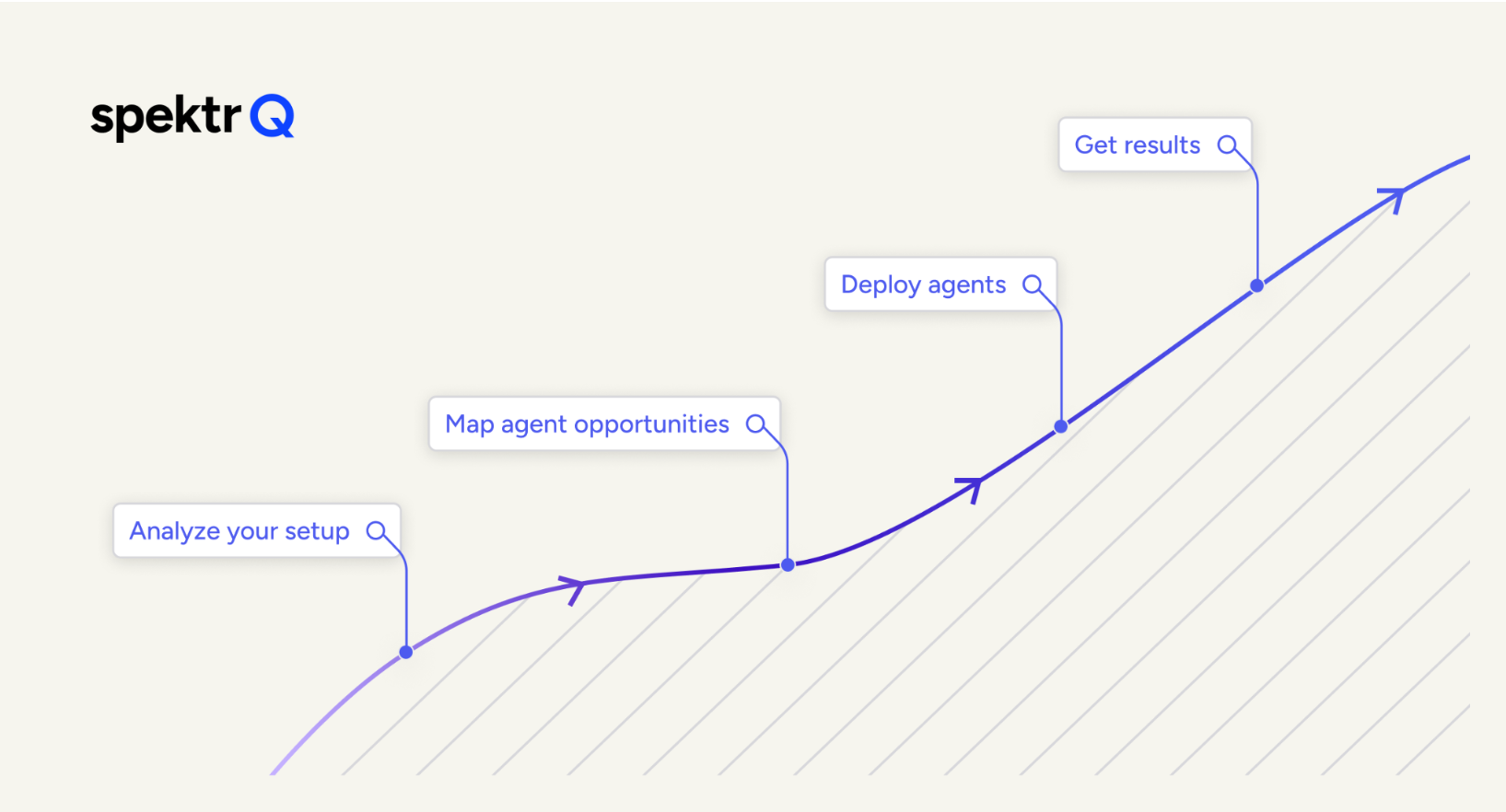
The spektrQ engagement model follows four stages: they analyze your setup, help you to map out agent opportunities, deploy agents, and show measurable results.
But ask a head of compliance the same question and you'll probably get a pause. Which is strange, because compliance is built around exactly the work AI is meant to be good at: gathering information, making judgments against rules and precedents, keeping records. On paper it is a perfect fit, yet in practice industry-wide tangible impact is yet to be felt.
The burden keeps climbing on its own terms. BPI found that between 2016 and 2023 the hours that employees at banks spend on compliance rose 61%, against a 20% rise in total hours. SteelEye's 2025 survey points the same way: spend is up and the day-to-day manual work load hasn't moved. AI was supposed to change that, and adoption is already high, but hasn't reached the work yet. In fact, BCG found that fewer than one in ten banks have measurable GenAI use cases in operation. Most are still in pilots. That means the capability is in the building, but the cost curve hasn't bent because the capability hasn't reached the daily workflow.
The machine still generates a lot of junk work, even with AI. In many screening and monitoring workflows, false positives remain above 90%. Analysts still clear piles of alerts that go nowhere and backlogs are growing.
Both are true at once because most of that spend is still going into building the capability, not yet into removing the work. The investment is real, but the payoff is mostly still ahead.
Whilst the industry-level numbers exist, what a compliance leader still can't do is quote one for their own function. They have bought the enterprise AI infrastructure. Turning it into daily risk workflows is where it stalls. Where to put it first, in what order, and whether the output will survive scrutiny years later by someone who wasn't in the room. That's what ultimately keeps compliance teams up at night; the MLRO whose name is on the filing and can't tell a regulator in good faith 'the AI agent decided'. A black box is completely unusable here. Compliance requires an auditable and defensible answer…and generic AI certainly doesn't produce one.
Two banks can look at the same customer and reach opposite, entirely defensible conclusions, because the right answer tracks each institution's specific risk appetite and controls. There's no universal compliance logic for a model to learn. The question of where AI belongs can't be answered by the model itself, it has to be answered by the people who understand the problem.
That, inevitably, makes fear compound. Moving without a clear map, without knowing which workflows to touch, in which order, with which guardrails, is how you bolt a new category of risk onto the function least equipped to absorb it.
When the workflow is right, the gains are real. BCG's 2025 work on AI in KYC puts the cost reduction at up to 50%, with productivity gains of 30% to 40% in the research and synthesis heavy parts of the process. At system level, Nasdaq and BCG put $25 billion to $50 billion in annual efficiency on the table across bank risk and compliance functions.
The manual cost comes out of the parts where human judgment was never the point in the first place: redundant screening runs, repetitive document review, stale backlog clearing, checks that are identical every time. What remains is the part that will always require a human in the loop: escalation, judgment and accountability.
We have already seen that in practice. At one of Europe's largest PayTechs, 97% of redundant UBO screening runs were eliminated. At a neobank, the lag between a real-world change and the internal update dropped 83%. At a European marketplace, document review that used to be manual now runs in < 60 seconds per document.
That is the opportunity. However, pinpointing it requires someone who sits at the intersection of AI engineering, compliance operations, and regulatory defensibility. It's a combination that's inherently unique, and therefore rare to come by. We know, because the same question comes up in conversation after conversation with compliance teams: where should AI go first? Not in theory. In their actual operation, with their actual workflows, controls, timelines and regulators. Most teams don't have anyone whose entire job is to answer that.
At spektrQ, that question is where we start. Before a single agent ships, we map the compliance workflows, identify where AI lands measurable impact, and build the roadmap together. We're a team that has spent years deploying AI in production compliance environments and knows the difference between a workflow that looks automatable and one that actually is.
Every other function has found a way to turn AI into a number it can stand behind. Compliance can get there too. What has been missing is the map.
Request your compliance AI workflow map here.
About spektr
spektr is a compliance automation platform built for banks, fintechs, and financial institutions. spektrQ is spektr's embedded expert team – compliance practitioners and AI deployment specialists integrated into every enterprise client relationship from day one – helping financial institutions identify and act on their highest-value AI opportunities in compliance. spektr is headquartered in Copenhagen, with offices in London and Iași.
Sources & References
Dell'Acqua, F., et al. "Navigating the Jagged Technological Frontier." Harvard Business School Working Paper 24-013, 2023.
Peng, S., et al. "The Impact of AI on Developer Productivity: Evidence from GitHub Copilot." arXiv:2302.06590, 2023. https://arxiv.org/abs/2302.06590
Brynjolfsson, E., Li, D., Raymond, L. "Generative AI at Work." NBER Working Paper 31161, 2023. https://www.nber.org/papers/w31161
Bank Policy Institute. "Survey Finds Compliance is a Growing Demand on Bank Resources." 29 October 2024. https://bpi.com/survey-finds-compliance-is-growing-demand-on-bank-resources/
SteelEye. "2025 Annual Compliance Health Check Report." June 2025. https://www.steel-eye.com/news/compliance-budgets-surge-as-ai-adoption-accelerates-and-regulatory-fines-loom
BCG. "A Faster Path to Scaling GenAI in Banking Compliance." 19 November 2025. https://www.bcg.com/publications/2025/a-faster-path-to-scaling-genai-in-banking-compliance
Bank of England and FCA. "Artificial Intelligence in UK Financial Services 2024." 21 November 2024. https://www.bankofengland.co.uk/report/2024/artificial-intelligence-in-uk-financial-services-2024
LexisNexis Risk Solutions. "The True Cost of Compliance." July 2024. https://risk.lexisnexis.co.uk/about-us/press-room/press-release/20240718-fighting-financial-crime-and-fraud
BCG. "The Know-Your-Customer Agentic AI Revolution." October 2025. https://www.bcg.com/publications/2025/know-your-customer-agentic-ai-revolution
Nasdaq and BCG. "The New Growth Imperative." 22 January 2025. https://ir.nasdaq.com/news-releases/news-release-details/nasdaq-report-identifies-between-25-billion-and-50-billion
Client results (97% redundant UBO screening eliminated, 83% faster real-world-to-internal update, <60 seconds per document). spektr client engagements.
spektr Communications
spektr
email us here
Legal Disclaimer:
EIN Presswire provides this news content "as is" without warranty of any kind. We do not accept any responsibility or liability for the accuracy, content, images, videos, licenses, completeness, legality, or reliability of the information contained in this article. If you have any complaints or copyright issues related to this article, kindly contact the author above.
